Wholesale Henna Powder for Mexico: Why 120+ Mesh Triple-Sifted Quality Is the Standard Smart Buyers Demand
Mexico’s beauty market runs deep. Walk into any mercado in Guadalajara, any salon strip in Mexico City, or any natural cosmetics shop in Monterrey, and you will find customers who already know what henna is — and who have strong opinions about quality. That is exactly why sourcing wholesale henna powder for the Mexican market is not as simple as finding the lowest price per kilo. The buyers who have been doing this for a few years will tell you the same thing: mesh count and sifting stages separate the product that sells from the product that sits.
Mexico’s Natural Beauty Market Has Outgrown Cheap Imports
Something shifted in Mexico’s beauty industry around 2019 and it accelerated sharply after 2021. Consumers started reading labels. They started asking what “natural” actually meant. Social media gave small brands a direct line to their customers — and those customers started pushing back on anything synthetic.
Henna landed in the middle of that shift perfectly. It is genuinely natural. It has centuries of use across multiple cultures. And it works — if the quality is right.
The problem was that not all henna imported into Mexico was the same. Some was coarse, inconsistent, and gave patchy results. Some turned orange on dark Mexican hair tones when customers expected brown. Some had gritty texture that made mixing difficult in a professional salon setting.
The salons and brands that figured out why this was happening — and traced it back to mesh count and sifting — started sourcing differently. They stopped asking “how cheap?” and started asking “how fine?”
What 120+ Mesh Actually Means in Practice
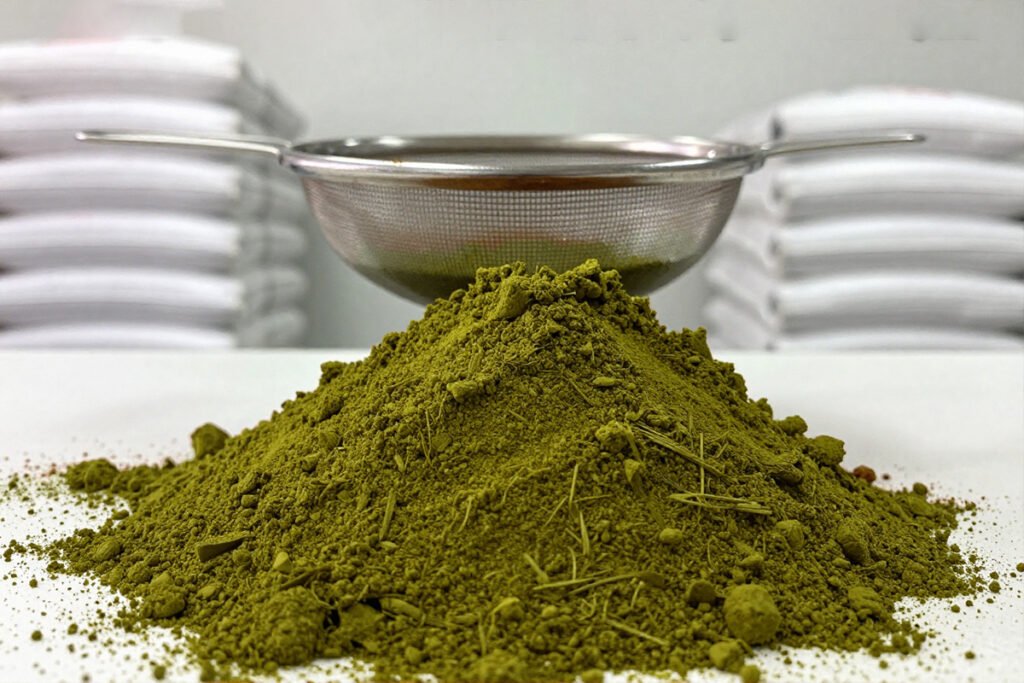
Mesh count describes how fine a powder is. A 120-mesh screen has 120 openings per linear inch. Powder that passes through it is fine enough to feel smooth between your fingers. Anything below that — 80-mesh, 100-mesh — has larger particles that you can feel if you rub it.
For wholesale henna powder for hair, that texture difference is not cosmetic. It changes how the paste behaves:
- Fine powder dissolves evenly in water or lemon juice — no lumps, no uneven spots
- It spreads more uniformly across the hair shaft — every strand gets coated the same way
- The dye releases more consistently — the lawsone molecule reaches the hair protein without interference from bark or stem fragments
- The paste stays workable longer — coarser powder absorbs liquid faster and can dry out mid-application
For professional salons in Mexico City working on multiple clients back to back, that last point alone is worth paying a premium for. A paste that dries too fast mid-session creates uneven results and wastes product.
Triple-sifting gets the powder to that 120+ mesh benchmark reliably. Single-pass sifting rarely does.
The Story Behind Starting a Henna Brand — and Why Quality Becomes Personal
There is a piece worth reading for anyone thinking about launching their own henna brand in Mexico or Latin America. The day I decided to start my own henna brand captures exactly the moment when sourcing decisions stop being abstract and become personal — when you are the one putting your name on the product and you realize that the quality of your supplier is the quality of your brand.
That shift in thinking — from buyer to brand owner — is what drives most Mexican entrepreneurs toward asking harder questions about mesh count, sifting, certifications, and traceability. Once your name is on the packet, cheap and inconsistent is not a trade-off you can afford.
Why Sojat Henna Is Still the Reference Point for Latin American Buyers
A lot of wholesale henna powder in India comes from different growing regions — Gujarat, Madhya Pradesh, and Rajasthan all produce henna commercially. But the Sojat region in Rajasthan’s Pali district has held its reputation for one specific reason: lawsone content.
Lawsone is the active dye compound in henna. Higher lawsone means deeper color, faster staining, and better longevity on the hair. Sojat’s combination of dry climate, alkaline soil, and traditional cultivation practices produces leaves with consistently higher lawsone concentration than most other growing areas.
For the Mexican market — where customers often have thick, dark hair with strong natural pigmentation — that higher dye content matters even more. A henna with low lawsone content will barely show on dark hair. A Sojat-origin powder with 2.5–3.5% lawsone will give a noticeable warm tone that customers actually see and appreciate.
That is why serious importers across Latin America ask for Sojat specifically. Not because it is a brand name, but because it is a quality marker they have learned to trust through experience.
If you are still at the stage of evaluating different suppliers, this guide on finding reliable henna powder suppliers walks through the practical verification steps that experienced buyers use before placing a first bulk order.
Case Study: How KEO Solved the Consistency Problem for International Buyers
Kirpal Export Overseas (KEO), founded around 2000 by Mr. Sunil Walia in Rajasthan, operates today under the leadership of both Mr. Sunil Walia and Vice-President Mrs. Payal Walia. Over 25 years they have built a supply chain that specifically addresses the problems international buyers — including those sourcing for Latin American markets — run into with commodity-grade henna.
They Started at the Farm
Most henna trading companies buy from aggregators. KEO built direct relationships with farms in the Sojat region. Every batch traces back to a specific growing source. Buyers can view farm photos. Some have visited.
That traceability is not just a marketing point. When a buyer in Mexico needs to show their retail customers where their product comes from — increasingly expected in the natural beauty space — that documentation exists and it is verifiable.
They Put Quality Checks at Every Stage
Moisture content testing. Dry powder color verification. Mesh size confirmation. Lawsone content documentation. Every batch that leaves KEO’s facility comes with a Certificate of Analysis. That paperwork matters for import into Mexico, where COFEPRIS (the Federal Commission for Protection Against Sanitary Risks) governs cosmetic ingredient imports and requires proper documentation.
Having that COA ready before shipment is the difference between fast customs clearance and a container sitting at Veracruz or Manzanillo port for three weeks.
Certifications That Matter in the Mexican Market
KEO holds ISO, GMP, and HALAL certifications. For Mexico, GMP certification is particularly relevant — it signals that production follows controlled, hygienic, repeatable processes. That aligns with COFEPRIS import requirements and gives buyers a document they can actually show to regulatory bodies if asked.
OEM and Private Label for Mexican Brands
KEO’s private-label service is what a lot of emerging Mexican beauty brands actually need. You bring your brand concept and packaging design. They handle sampling, production, and export-ready packaging — including active moisture protection for sea freight routes through the Pacific to Manzanillo or Lázaro Cárdenas.
For a Mexican entrepreneur who wants their own henna hair care line without building a manufacturing infrastructure, that service compresses a year of complexity into a manageable supplier relationship.
You can explore payalwalia.com for more context on how these OEM supply chains are structured and what buyers at different stages of business development typically need.
Matching Henna Color Results to Mexican Hair Types
This is a practical consideration that a lot of importers overlook until their retail clients start asking questions. Mexican hair spans a wide range — thick black hair, medium-brown hair, hair that has been previously color-treated. Not every henna will behave the same across that range.
High-lawsone Sojat powder gives warm reddish-brown tones on dark natural hair. On lighter or previously bleached hair, the orange tone is stronger. Blending with indigo shifts the result toward brown or dark brown, which is often what Mexican salon clients actually want.
Understanding that color behavior — and being able to explain it to retail clients — is part of what separates a knowledgeable importer from one who just resells whatever they imported. This guide on hair colors by skin undertone covers the color matching logic in a way that is genuinely useful for advising customers.
Buying Wholesale Henna Powder for the Mexican Market — What to Check
Here is a practical rundown of what experienced Mexican importers verify before committing:
Product specs:
- Mesh fineness — 120-mesh minimum, 200-mesh for premium salon-grade
- Sifting stages — triple-sifted confirmation
- Lawsone content — ask for the lab result
- Moisture content — below 10%
- Dry powder color — bright green signals fresh product
Supplier documentation:
- Certificate of Analysis (COA) — required for COFEPRIS
- MSDS or safety data sheet
- Phytosanitary certificate for plant-based products
- Certificate of origin
- ISO, GMP, HALAL certifications where applicable
Logistics considerations:
- Packaging moisture protection for sea freight via Pacific routes
- Lead time from order to dispatch
- MOQ flexibility — important for first orders
- OEM/private-label availability
For an independent evaluation of how herbal hair color products are assessed by buyers and brands globally, herbalhaircolors.com is a useful reference to keep bookmarked.
And if you want a deeper breakdown of what differentiates quality wholesale henna powder manufacturers from commodity suppliers, the analysis at quality wholesale henna powder manufacturers is worth reading before you finalize any sourcing decision.
Mexico-Specific Buying Notes
A few things that are specific to sourcing for Mexico that general guides tend to skip:
- COFEPRIS documentation is not optional. Any cosmetic ingredient imported commercially needs proper documentation. A supplier who cannot provide a COA and MSDS creates real customs risk.
- Veracruz and Manzanillo are the two main entry ports for Indian goods arriving by sea. Manzanillo handles most Pacific freight. Moisture protection in packaging matters for both routes given transit times.
- The Día de los Muertos and quinceañera seasons drive real spikes in henna demand. Body art henna consumption goes up significantly in October–November. Buyers who plan ahead for that window do not scramble for stock in September.
- Mexico City, Guadalajara, and Monterrey have the highest concentrations of professional salons. These are the buyers most likely to care about mesh count and consistency — and most likely to become repeat customers when the product performs.
FAQs
Q . What is the right mesh count for professional salon-grade wholesale henna powder?
Ans. 120-mesh is the minimum for smooth paste and even application. Premium salon-grade powder is typically 200-mesh or finer. Always ask your supplier for the documented mesh fineness — a claim without documentation is not worth much.
Q. How do I find the best wholesale henna powder online that ships to Mexico? Ans. Look for Indian exporters with verifiable ISO, GMP, and HALAL certifications. They should provide a COA and phytosanitary certificate with every shipment. Ask about moisture protection in packaging — sea freight to Mexican ports takes time and humidity affects quality.
Q. Why does henna turn orange instead of brown on Mexican hair? Pure henna Ans. produces a reddish-orange tone because of how lawsone bonds with keratin. On dark hair the result is a warm auburn. For true brown results, henna needs to be blended with indigo powder. A good supplier will explain this and supply both powders.
Q. Is triple-sifted henna powder significantly more expensive than standard grade?
Ans. The price difference is usually modest — typically 10–20% more than single-pass commodity grade. Given the reduction in customer complaints, returns, and wasted product in professional settings, most experienced buyers consider that margin worth it easily.
Q. Can I import wholesale henna powder from India directly to Mexico?
Ans. Yes. India and Mexico have active trade in cosmetic ingredients. The key requirements are proper documentation — COA, MSDS, phytosanitary certificate, certificate of origin — and a supplier experienced with export paperwork. Experienced exporters like KEO handle this regularly.
The Short Version
The difference between wholesale henna powder that moves and powder that sits is almost always traceable to the same two things: mesh count and sifting stages. Mexican buyers who have learned that lesson the hard way are now the ones asking the right questions upfront — and they are building supplier relationships that last because the product consistently does what it is supposed to do.
120+ mesh, triple-sifted, Sojat-origin, certified and documented. That is the checklist. Everything else is negotiable.
For additional research on henna sourcing and quality standards, Google’s curated henna overview is a useful starting point.
And for more context on the henna plant itself — its properties, uses, and what makes it a genuinely effective natural ingredient — the piece on henna leaves and their properties gives a grounding that helps buyers talk knowledgeably to their own customers.